
Pappas: Reform Runaway City & Cook County Property Taxes
Updated: Apr 22

By Don DeBat
Chicago and Cook County property owners are beaten, battered and bewildered by soaring real estate taxes. With wallets already flattened, homeowners are bracing for another big cash bite on April 1st, when the first installment of 2025 taxes are due.
According to a new study released March 30th by Cook County Treasurer Maria Pappas, real estate taxes in Chicago and the county have grown at double the rate of inflation over the past three decades.
As a result, home and business owners are being forced to pay an ever-greater percentage of their annual earnings to local governments while cancelling family vacations and dining on fast-food burgers, Spam and franks and beans.

During those 30 years, local governments in Chicago and Cook County imposed $19.2 billion in property taxes in 2024, up nearly 182% from the $6.8 billion taxed in 1995, according to the report. Over those three decades, inflation rose by 91%, while average wages grew by about 161%.
The Pappas study notes that the Illinois Dept. of Revenue is working on a comprehensive property-tax report, and urges that now is the time for Illinois lawmakers to pass significant tax reform and find ways for local taxing agencies to cut spending.

“The annual increases in property taxes are relentless, taking more and more money out of peoples’ pockets,” Pappas said. “Many people are wondering how they are going to pay their tax bills, or even whether they can afford to stay in their homes.”
Illinois in 2025 had the highest residential property tax rate in the nation. “And, Chicago has the highest commercial property tax rate in the U.S.,” Pappas said. “It’s time for the governor, state lawmakers and local government leaders to come up with a real reform plan that works for taxpayers.”
Property taxes skyrocketed despite a state law designed to limit tax increases, primarily because government leaders have exploited loopholes in the law, Pappas charged. Here is a summary of those key loopholes:
• Tax-increment finance districts. Government is placing no limits on property-tax increases in special taxing districts.
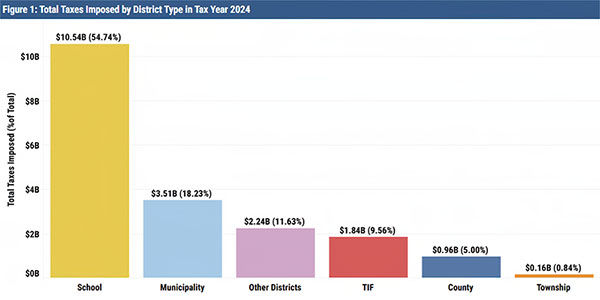
A portion of property tax money in each district simply is set aside to subsidize private development and job creation. Taxes in those wide-spread tax-increment finance (TIF) districts, which have dramatically multiplied over the years, grew more than 1,000%, exceeding $1.8 billion in tax year 2024.
• K-12 school district taxes. A 189% increase in taxes imposed by K-12 (kindergarten to senior-high) school districts far outstripped the 91% inflation rate. A total of 153 school districts levied more than $10.5 billion in taxes in 2024, accounting for nearly 55% of the total county property-tax burden.
To see why their property taxes have skyrocketed, all Chicagoans have to do is look at the line on their bill earmarked for the Chicago Board of Education. That expenditure is a crushing 45% of their total tax bill.
“Every taxpayer is forced to foot the bill for Chicago’s inferior public schools, even if they are young couples with no kids in school, senior citizens with grown children, and parents who pay to enroll their children in private or parochial schools,” one childless, senior homeowner complained.
“What we need is a special-assessment exemption category for homeowners who do not have children enrolled in Chicago Public Schools (CPS),” suggested another senior homeowner, who recently was hit with a 21% tax hike. “That would cut my property tax bill nearly in half.”
The study, titled: “How State Laws Failed to Stop Decades of Skyrocketing Property Taxes: A Case for Reform,” notes that state legislators have long been aware of the unsustainable upward trajectory in property taxes, but despite producing a slew of studies and legislative initiatives, have failed to provide relief for businesses and homeowners.
In some cases, state government made the problem worse by enhancing local government pension benefits and lowering the share of state revenue passed along to cities and villages, whose taxes increased by 201% over the 30-year period, Pappas said.
Although the state Property Tax Extension Limitation Law (PTELL) was designed to limit tax increases to the rate of inflation or 5%, whichever is less, local officials took advantage of that law’s loopholes to enact tax increases that substantially exceeded that limit.” Pappas said.
For example, K-12 school districts, which accounted for 55% of county property taxes in 2024, increased property taxes to an amazing $10.5 billion from $3.64 billion, or 189.4%, over the 30-year period in 153 districts.

Tax-increment finance (TIF) districts, in which property taxes are diverted to subsidize private development and promote job growth, increased taxes by more than 1,000%, to $1.84 billion.
Over the past 30 years, the number of TIF districts in Chicago and its suburbs exploded, increasing their portion of the tax bill to nearly 9.6% from 2.4%.
Pappas outlined the gaping loopholes that allowed those increases to dramatically exceed the rate of inflation:
• Home-rule municipalities, which are granted more leeway by the state to increase taxes, are not bound by PTELL.
• Local government agencies can increase their taxes beyond PTELL limits if voters approve higher taxes in a referendum. That occurs frequently, often in very low-turnout elections that allow a minority of motivated voters to decide whether taxes go up.
• TIF district tax increases are not limited by PTELL. TIF surpluses can be distributed to local taxing agencies with no limits, and when TIF districts close, their taxes can be added to local taxes above and beyond PTELL limits.
• New funds that allowed Chicago Public Schools (CPS) to reinstate a property tax levy dedicated to public pension payments, are not bound by PTELL in their first year. In the case of CPS, the state also eliminated PTELL limits on that reinstated tax in future years.
• Other gaping loopholes include exempting certain bond issues from PTELL and allowing taxing agencies to increase their levies beyond PTELL limits to “recapture” taxes refunded through taxpayer appeals.
“Local governments for many reasons may feel the need to exploit PTELL loopholes,” Pappas said. “Key among those is that the state of Illinois provides just 24% of all K-12 public-education costs, the lowest percentage of any state.”
For Chicago Public Schools, the issue is compounded because—unlike the rest of the school districts in the state—it pays for most of its own pension costs, driving up the financial burden on Chicago taxpayers, Pappas noted.
“Municipalities across the county are grappling with two primary fiscal pressures: state mandates to contribute more to poorly funded public pensions, which were battered by economic downturns, and a cut in the percentage of state revenues shared with municipalities,” Pappas noted.
The Treasurer’s study points out that other local taxing agencies, such as Cook County government and the Chicago Park District, have managed to keep taxes below the rate of inflation by turning to other revenue sources. For example, a 1-percentage point increase in the sales tax for the county, and fees from events and programs for the Chicago Park District have kept increases lower.
Although property tax protests have been increasingly frequent, the issue of runaway property taxes is not new, the study notes.
The study documents several property tax studies and proposals dating back to 1982 that either ended up going nowhere or failed to win approval. As a result, property taxes continue to soar.

Currently, the Illinois Dept. of Revenue is studying the Illinois property tax system, with an end-of-July 2026 deadline.
Photo by Brian Scantlebury
Given the heightened awareness of the tax burden on property owners, the Cook County Treasurer’s study suggests the time may be ripe for the General Assembly to finally provide property tax relief to Illinois residents and businesses.
To read the full report, please visit: http://cookcountytreasuarer.com
For more housing news, visit www.dondebat.biz. Don DeBat is co-author of “Escaping Condo Jail,” the ultimate survival guide for condominium living. Visit www.escapingcondojail.com.


Comments