
Chicago Bears Should Stay Put And Save City Billions
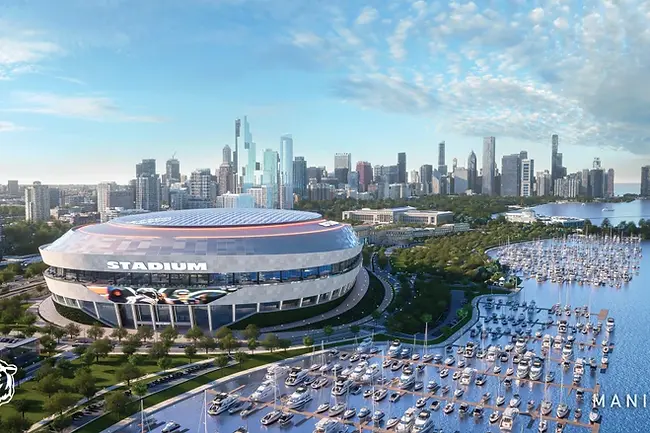
By Don DeBat
Like buzzards circulating an animal carcass, commercial real estate developers and greedy politicians are salivating over the mega-bucks they could pocket on building a new Chicago Bears domed stadium.
When we hear about Illinois politicians frying up the pork, this is where it starts.
However, the truth is, if this is all football, and keeping the Bears in Chicago, all we really need is a Soldier Field renovation that includes more seats and the installation of a retractable domed roof on the existing stadium, which was remuddled in 1982.
Like balloons at a circus, at least five multi-billion-dollar new stadium plans are being floated after the Bears posted a rare winning season in 2025, and are off to a 7-2 record in 2026. Diehard fans and the goo-goo-eyed “Monsters-of-the-Midway” brass now have visions of a Super Bowl dancing in their heads.
With a potentially winning franchise, the profit-hungry sports team, and its talented quarterback, are eager to sack the Windy City. They are planning a new stadium, and are considering two sites—one in northwest suburban Arlington Heights, where the Bears own the land, and another in Hammond, IN.
Three more glittering, new stadium sites also are being considered. One is in the South Side Bridgeport neighborhood where a new domed stadium would be built at Rate Field and spark a move of the Chicago White Sox to the South Loop. Another calls for construction of a new domed stadium on the former U.S. Steel-plant site—a toxic tract on the Far South Side lakefront.

Last week, the latest new $10-billion, 100-acre pie-in-the-sky plan on the long-vacant former Michael Reese Hospital site in Bronzeville, involves razing 1,000 Prairie Shores housing units and displacing long-time residents. Developers are so pumped up on this fourth-quarter “Hail Mary” they say they are willing to buy the Bears’ Arlington Heights property.
Imagine the Bridgeport Bears, the Bronzeville Bears and the Toxic-Steel Bears? All are bad choices.
Plans for the trio of proposed new stadiums look like they were drafted by the same dizzy architectural firm with a stock-dome image designed by cookie-cutter Dunkin’ Donuts. The plans do not even add sprinkles. And, each stadium choice would cost $3 billion, experts say.
What’s worse, two of the plans involve moving the team into residential neighborhoods and tearing down or gentrifying thousands of housing units. The third features toxic soil infused with heavy metals that likely glows in the dark.
What would Pulitzer-Prize winning columnist Mike Royko, and his common-sense alter ego Slats Grobnik, say about this diabolical situation? Royko was a life-long Bears fan who watched dozens of games at the cramped Wrigley Field in the 1960s.
The Bears should stay put!
For a common-sense, super-fan assessment, the Home Front column interviewed Mr. Zak—its own Slats Grobnik. Mr. Zak, our go-to, blue-collar source for casinos, sports stadiums, and urban planning, declared: “The Bears should stay put! If they move, and they probably will, it’s all about money, not tradition, or love of their loyal fans.”
The astute Mr. Zak estimates that adding a dome and 20,000 more seats in a new deck and swank roof-top skybox seats would only cost $700 million—a savings of $2.3 billion. A second Soldier Field remodel would likely bring an elusive Super Bowl to Chicago within a few years.
And, national TV football viewers would continue to ogle that beautiful, downtown skyline view the networks love to show in pregame warmups.
Hopefully, a new domed Soldier Field will help architecture critics forget about the earlier remuddling that looked like a giant flying saucer had crashed into the once-historic landmarked Soldier Field.
Soldier Field lost its National Historic Landmark status in Feb. 2006 because of that botched renovation. The National Park Service and federal advisory boards determined that the flying saucer completely destroyed the historic architectural integrity and character of the landmark.
Not only is the renovated Soldier Field ugly, oddly it only seats 61,500 people and doesn’t have a dome, the standard design ingredient for a Super-Bowl stadium. What were the leaders of Chicago thinking? The sit once could seat over 100,000 people.
Designed in the 1920s to resemble the Greek Parthenon, Soldier Field honors our World War I veterans. Massive events easily drew six-figure attendance, including 104,943 spectators for the famous 1927 Jack Dempsey and Gene Tunney heavyweight rematch (“the long count”) and 150,000 people for a wartime visit by President Franklin Roosevelt in 1944.
Soldier Field memories
However, over the years, this writer has grown to nostalgically accept the renovated stadium. Memories of the original Soldier Field dates back to my first visit there in 1959 while attending the city’s high school football championship. My alma mater, Lane Tech, the Public League Champ, beat Fenwick, the Catholic League champ, 19-0 in the snow.
Another forever memory at Soldier Field before it was remuddled, was the 1975 Windy City 16-inch softball World Series played on a diamond laid out at the north end of the old stadium, thanks to the vision of Chicago Park District czar Ed Kelly, an inductee in the 16-inch Chicago Softball Hall of Fame.

Some 30,000 softball fans watched the South Side ERV-Strikers edge the suburban Big Banjo Bruins 8-7 in the championship game broadcast on WTTW-TV. As a softball writer for the Chicago Daily News, I covered the game, and helped TV announcers Mike Royko and Tim Weigel, my Chicago Daily News teammates, do color commentary.
Today, Mr. Zak not only likes the idea of installing more seats and a dome on Soldier Field. He also favors the concept of building an entertainment mecca west of the domed Soldier Field on the air rights Outer Lake Shore Dr. and the Metra railroad tracks.
Earlier, Mr. Zak, a professional gambler, suggested the best place to launch the new Chicago casino was at the original McCormick Place, a stone’s throw south across a parking lot from Soldier Field. That property is operated by the Metropolitan Pier and Exposition Authority, which is a joint municipal corporation created by the Illinois General Assembly.
Under the Illinois Gaming Board rules, major sports venues can apply for a license to host a physical, brick-and-mortar retail sportsbook, but the Bears have never built a betting site at Soldier Field due to lease restrictions and stalled negotiations with the City and CPD.
Under the NFL and their players association collective bargaining agreement (which runs through the 2030 season), teams and players share revenues generated by gambling businesses located inside or physically attached to an NFL stadium. During the NFL season, 100% of this revenue is included in the league's shared revenue pool used to calculate the player salary cap. Out of season, 50% of the revenue from an in-stadium operation is counted toward the player pool.
Capturing more game-day and venue-related revenue streams is a major reason the Bears want a new, team-controlled stadium. A new facility would give them full control over commercial developments, retail partnerships, and potential on-site betting lounges without needing approval from the city.
“Unfortunately, former Mayor Lightfoot took a $40-million “donation” from Bally, and the financially-troubled casino now is under construction at the worst possible site, on congested Halsted St. and Chicago Ave.,” Mr. Zak said.
***
Don DeBat is co-author of “Escaping Condo Jail,” the definitive guide to condominium living. A veteran real estate voice, he provides essential insights for navigating communal ownership at escapingcondojail.com. Stay updated on housing news at dondebat.biz. Don is currently writing “Chicago’s Game,” a look at the history and lifestyle of 16-inch softball.


Comments